Check what the creator can change
Permissions can let someone create more units, freeze accounts, restrict transfers, change fees, or upgrade the relevant program. Check these alongside existing holdings. Even a small creator balance matters if the rules allow more issuance or blocked transfers.
For standard Solana tokens, check mint and freeze authorities. Minting means creating more units; freezing stops affected accounts transferring while frozen. For Token-2022 and other chains, inspect the relevant extensions, contract roles, administrators, and upgrade rights.
How many more can they mint?
Find who can create units and what enforced cap applies. If you cannot verify a cap, mark future issuance unresolved. A permanently revoked authority disables that minting path under the relevant token mechanism. Continue checking other controls.
Read mint, freeze, and metadata/update authority fields separately. A generic Authority label may show only one of them. For transfer restrictions and fee changes, record affected users, exemptions, rates, caps, activation delays, and who can change the settings. Check recent ordinary-wallet sales and failed transaction reasons; quotes and simulations can change before execution.
Count the tokens available now
Providers use total supply, circulating supply, and float differently. Float usually describes a measure of available units; save the provider's definition. Separate pool reserves, burned units, locked allocations, treasury units, and ordinary balances. Check restrictions before excluding treasury tokens.
Use the available holder supply defined in Section 5 for the example concentration screen. If custody or restrictions are unclear, save known units and leave that percentage unresolved. Transferable tokens may still be difficult to sell when liquidity is thin.
Read the lock and release schedule
A token lock or vesting contract releases specified units over time. A cliff is a scheduled release on a date; periodic vesting releases amounts at intervals. Some units may already be claimable, meaning the recipient can withdraw them now, even when the contract runs for another year.
A liquidity lock covers a specified trading position. Check it separately in Section 7. Platform and project rules determine whether locks are mandatory or voluntary.
Read deposited, withdrawn, claimable, and still-locked amounts using the provider's definitions. Save the beneficiary, next release and timezone, amount per release, start, cliff, end, cancellation rights, and recipient-change rights. Where permitted, Streamflow cancellation can return unvested units to the sender.
How to investigate it
- Open the exact mint or contract and its owner program. Inspect each authority, extension, role, cap, fee setting, and delay.
- Save controller addresses or revoked status, source, and time. Use decoded data or a supported inspector for missing fields.
- Check ordinary-wallet transactions, exemptions, and failure reasons under current settings.
- Match the lock or vesting contract to the chain and token. Read its dashboard and documented schedule; checking does not require a signature or claim.
- Record already available units, the next release, beneficiary, and change rights. Avoid counting withdrawn or claimable units twice.
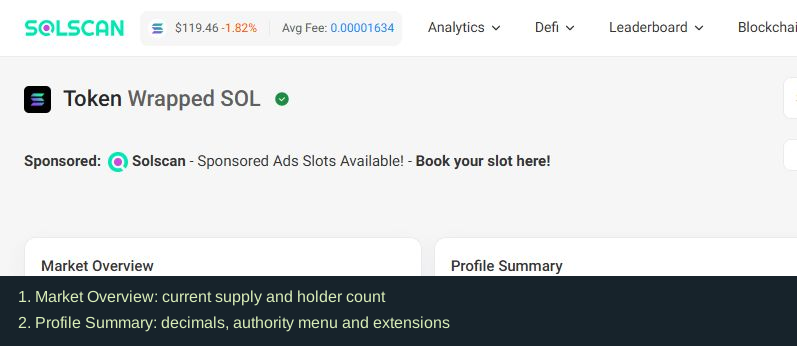
Find Current Supply, Decimals, the Authority menu, and Token Extensions. Open specific authority details before recording mint or freeze status; a summary label can refer to a different authority.
Captured 5 October 2026 on the public Wrapped SOL page. This is a navigation example. Wrapped SOL has special token mechanics; its numbers and authority labels are not the SAMPLE case or a standard meme-token assessment. Open your own token address to do the checks.
Practical case — illustrative
At 09:25 UTC on Day 1, SAMPLE uses a standard token program with mint and freeze authorities revoked and no additional transfer controls. The group holds 12m available units; another 20m sits in team vesting.
No vesting units are claimable yet. 4m unlock at 09:00 UTC on Day 2, leaving 16m locked. Cancellation is disabled in this example. With no intervening trades, the group would hold 16m ÷ 104m available units = about 15.4% after release. Later examples show how sales change that starting balance.
An unlock makes tokens available. Check subsequent transactions to find out whether they are sold.
Keep this record
Save each permission's controller, possible action, source, and time. Add an unlock calendar with beneficiary, claimable units, release amount/timezone, and change rights. Keep current holdings separate from possible future holdings.
Add these findings to your review worksheet →
Check your understanding — answered
Minting is disabled. What remains? Check existing holdings, other powers, unlocks, liquidity, and buyers.
One wallet sold successfully. Can everyone sell? Check exemptions, ordinary-wallet sales, and current settings.
A lock ends in a year. Can units be sold today? Check claimable units and holdings outside it.
An authority field is missing, or an unlock is due tomorrow. What should I conclude? Mark the missing control unverified. Record the release and watch actual transactions before recording a sale.
Mechanism references
Solana: set or revoke authority ↗
Solscan: program and upgrade details ↗
Streamflow: vesting schedule ↗
Streamflow: claimable tokens ↗
SAMPLE is made up for this course. Date each finding. For a real token, use current transaction records and platform rules. Inspect shows sampled trades; use external records to check ownership and permissions.